

We’ve spent the last few posts in this series doing some much needed engineering sanitation. We migrated away from the deprecated monolithic ingress-nginx model, automated our edge TLS using ReferenceGrant and Cert-Manager, and broke down the head-to-head realities of the top Kubernetes Gateway API controllers.
If you followed the playbook, your core application routing layer is now stable, portable, role-oriented, and decoupled.
But as a platform engineer, your job is never actually finished. The moment you stabilize your core infrastructure for traditional microservices, your engineering directors and product teams drop a massive new challenge onto your desk: "We are deploying autonomous AI agents into production, and they need access to our internal systems."
Suddenly, your clean, stateless, request-in-response-out L7 proxy architecture is hit by a wave of stateful, long-lived JSON-RPC sessions, dynamic tool execution, and chaotic AI workflows.
Today, we are going to look at the next massive infrastructure paradigm shift: how the Kubernetes Gateway API standard scales to govern Large Language Models (LLMs), the Model Context Protocol (MCP), and Agent-to-Agent (A2A) communication using the Agentic AI Foundation's newly open-governed, Rust-native project: agentgateway.
Why Traditional API Gateways Break on AI Agents
When developers start building AI features, they usually treat them as standard application code. They drop third-party API keys directly into backend microservices and write hardcoded integration scripts.
This works for a local proof-of-concept. But the moment you scale autonomous agents across an enterprise cluster, your traditional network layer breaks down across three major fronts:
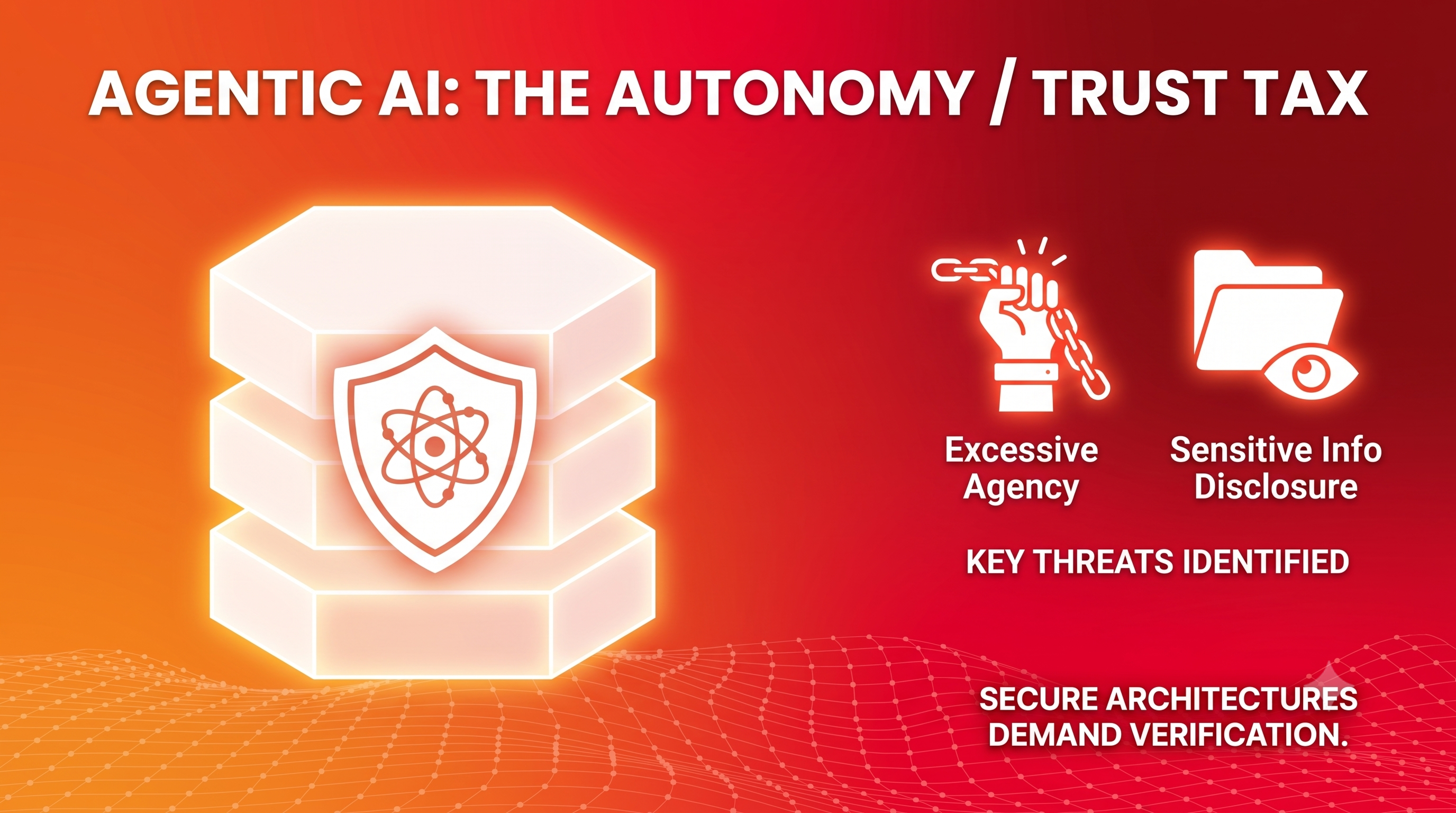
- The Statefulness Tax: Traditional gateways are built for quick, stateless REST or gRPC requests. But when an AI agent connects to an internal data source via the Model Context Protocol (MCP) or collaborates using Agent-to-Agent (A2A) protocols, the communication consists of long-lived, complex, bidirectional message streams.
- The Security Blindspot: Traditional RBAC operates at the network endpoint level (e.g., "Can user token X call path
/v1/data?"). An AI agent, however, executes dynamic tool calls based on text prompts. If a prompt tells an agent to invoke a local Postgres or GitHub MCP server, a traditional proxy cannot parse, intercept, or block that specific tool execution. You have no fine-grained control over what your agents are actually doing inside your network. - The Budget & Token Crisis: Agents don't make single API calls. They run multi-step reasoning loops. One user request can trigger twenty chained internal and external calls, resulting in massive token budget overruns, provider throttling, and unpredictable bills.
If your solution to this is to stitch together a "regular" API gateway for your apps and a separate, proprietary "AI Gateway" wrapper for your models, you are building a dual-headed operational nightmare. You need a single data plane that unifies both.
The Architecture of agentgateway
Originally contributed by Solo.io and now hosted as a vendor-neutral open-source project under the Linux Foundation (within the Agentic AI Foundation), agentgateway is a high-performance proxy engine written natively in Rust.
It does not compete with your Kubernetes Gateway API standard—it integrates directly with it. While your chosen controller (like kgateway or Envoy Gateway) manages the standard North-South edge entry points, agentgateway drops into your cluster to act as the specialized AI-native data plane.
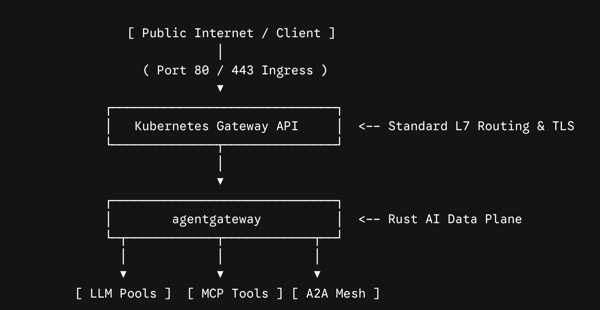
The engine acts as a unified triple-threat gateway:
- The LLM Gateway Layer: Exposes a single, unified, OpenAI-compatible API to your developers, while handling model fallback, latency-aware inference routing, load balancing across GPU pools (vLLM/TGI), and real-time token rate-limiting.
- The MCP Gateway Layer: Centralizes your tool ecosystem. Instead of exposing raw database connection strings or microservice endpoints directly to an AI model, your MCP servers register straight to the gateway. The gateway federates these tools into a single, secure catalog.
- The A2A Gateway Layer: Governs autonomous multi-agent systems (e.g., CrewAI, LangGraph) by managing task orchestration, message retry logic, and modality negotiation when agents collaborate.
Hands-On: Enforcing Tool-Level Security with Cedar Policies
We don't buy into "just trust the agent" design principles at ape factory. We require strict, deterministic guardrails. Because agentgateway is purpose-built for enterprise governance, it integrates Amazon's Cedar Policy Engine to enforce mathematical, fine-grained access control down to the individual tool invocation.
Imagine you have a customer support agent. It uses an LLM to chat with users, and it has been given access to two federated MCP servers: a CRM-Server (to read user profiles) and a Billing-Server (to issue refunds).
Without an internal proxy policy, a clever prompt injection could trick that support agent into issuing an unauthorized refund. With agentgateway and Cedar, you block this at the infrastructure layer.
Here is how you write a declarative, zero-trust policy directly inside your gateway layer to explicitly restrict the agent's actions:
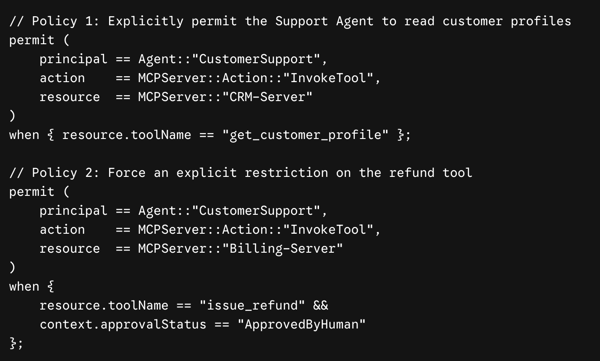
Why This Matters: The gateway evaluates this policy per tool call, not per API call. If the LLM generates a text thought chain that tries to invoke the issue_refund tool, agentgateway intercepts the JSON-RPC request, checks the runtime context attributes, and drops the connection with an explicit 401 Unauthorized before the backend billing service is ever touched. Your backend applications remain safe, regardless of how chaotic or compromised the LLM's prompt chain becomes.
Full-Stack Agent Observability with OpenTelemetry (And Why Your GreenOps Strategy Depends On It)
Debugging traditional microservices is hard; debugging autonomous AI agents is an absolute nightmare. If an agent loops infinitely, hallucinates a broken parameters schema, or gets stuck in a recursive tool-calling pattern, a standard HTTP request/response log tells you absolutely nothing.
Because agentgateway is built entirely on cloud-native observability standards, it features native OpenTelemetry (OTel) with OpenInference integration. When a client hits your cluster edge, the gateway generates a unique trace context. It maps the incoming prompt payload, tracks the Time-to-First-Token (TTFT), logs the specific JSON-RPC schemas passed to your federated MCP servers, and records the final token consumption metrics.
But at ape factory, we look past basic application traces. As we detailed in our guide on Beyond Token Costs: Tracking Green LLM Operations Using eBPF and OpenTelemetry, calculating cloud bills purely based on LLM token counts is a massive oversimplification. True GreenOps and platform governance require you to map application behavior directly to bare-metal resource consumption—measuring the exact Joules-per-Token overhead on your underlying GPU and CPU nodes.
By using agentgateway as your unified AI data plane, you gain the exact architectural hook needed to connect these two tracking mechanisms.
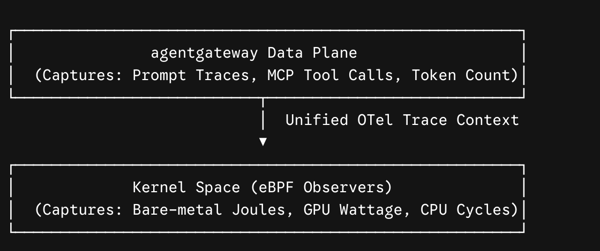
Because the gateway passes the standard OpenTelemetry trace headers downstream through every step of the agent execution chain, your underlying kernel-space eBPF observers can bind directly to the exact same context.
When an agent triggers a multi-step reasoning loop across multiple tools, your OpenTelemetry collectors aren't just aggregating stateless execution logs. You are feeding a single pane of glass that maps the high-level prompt trace all the way down to the physical, hardware-level carbon footprint of that specific agent's execution. You don't need a proprietary, closed-source monitoring silo; your existing Prometheus, Jaeger, and OpenTelemetry pipelines process the unified data natively.
Wrapping Up the Series: The Modern Cluster Platform
We have traveled a long way over these five posts:
- We broke out of Annotation Hell by embracing the role-oriented Kubernetes Gateway API specification.
- We locked down our namespace boundaries securely using
ReferenceGrantand automated our production certificates with Cert-Manager. - We mapped out an automated, risk-isolated migration path away from legacy
ingress-nginxusingingress2gateway. - We evaluated the controller landscape to choose the exact right proxy engine for our specific data plane throughput needs.
- And today, we extended that exact same architectural standard to govern, secure, and observe AI models and MCP tool servers via
agentgateway.
This is what a mature, future-proof cloud-native platform looks like. By choosing open, decoupled, vendor-neutral standards over comfortable proprietary cages, your platform engineering team is fully equipped to handle whatever architecture the industry cooks up next.
Are your development teams starting to experiment with shadow MCP servers or unchecked LLM keys?
------
Beyond Annotation Hell: The Series Roadmap
This article is part of our comprehensive guide to mastering the modern Kubernetes traffic plane. Check out the rest of the series to fully stabilize your infrastructure:
-
Part 1: The Post-Ingress Era: Why the Kubernetes Gateway API is Taking Over
-
Part 2: Secure by Default: Setting Up Gateway API + Free SSL (Cert-Manager)
-
Part 3: The Blueprint: Migrating from Ingress NGINX Using ingress2gateway
-
Part 4: The Ultimate Gateway API Provider Comparison: Cutting Through the Marketing Fluff
-
Part 5: The Next Frontier: Elevating Gateway API to Handle LLMs, MCP, and AI Agents

Never miss an update.
Subscribe for spam-free updates and articles.