Kubernetes Beyond Worker Nodes: From Virtual Kubelet to Serverless Computing
Understand how Virtual Kubelet delegates pod execution, why virtual nodes change Kubernetes scheduling, and where Knative fits into serverless Kubernetes.
On this page
Kubernetes was supposed to abstract infrastructure.
And yet, here we are. Managing node pools, configuring autoscalers, calculating resource requests and wondering whether we have enough capacity to survive the next traffic spike. We stopped managing individual servers. We did not stop managing infrastructure.
Virtual Kubelet challenges that operating model by asking a deceptively simple question: what if a Kubernetes worker node did not need to be a conventional worker node at all?
Instead of provisioning machines to execute workloads, Kubernetes can delegate execution to external compute platforms. But removing worker-node management solves only part of the problem. Someone still needs to decide how many application instances should exist, when they should start, how traffic should reach them and when they should disappear.
That is where serverless infrastructure ends and serverless application platforms begin. And that is where Knative enters the picture.
A worker node is an API abstraction
A conventional Kubernetes worker combines several responsibilities. The kubelet registers the node, reports its health and resources, watches assigned Pods and coordinates their execution through a container runtime. Networking and storage integrations provide the connectivity and volumes those workloads require.
The scheduler, however, does not directly inspect a physical machine. It evaluates Node objects, resource requests, taints, affinity rules and other scheduling constraints. Once it selects a node, the Pod is bound to that node. Execution is somebody else’s responsibility.
This separation creates an interesting possibility: the component responsible for executing a Pod does not necessarily need to execute it locally.
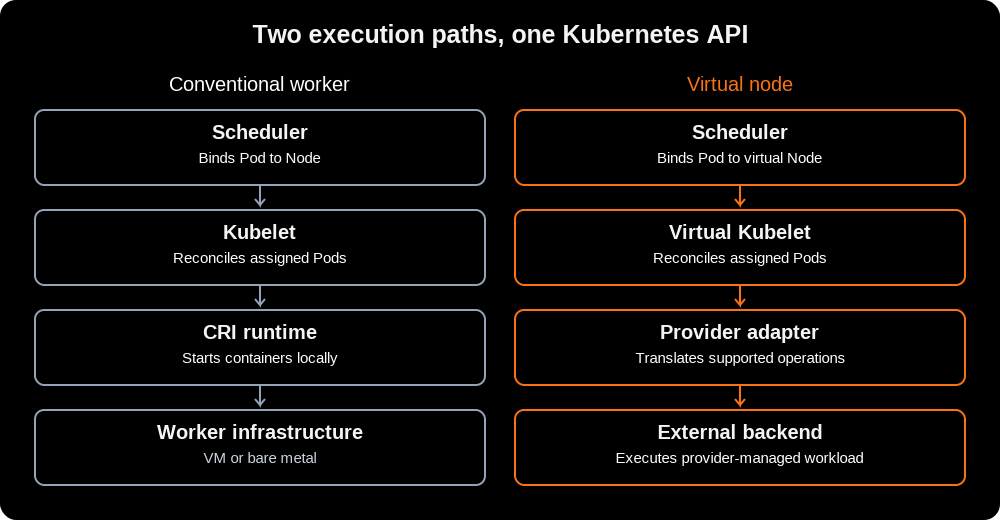
Virtual Kubelet implements this idea through a kubelet-like integration and a provider interface. It represents external execution capacity as a Kubernetes Node and delegates workload operations to a backend. The virtual node is real as an API object; it is not necessarily a dedicated machine.
The distinction matters. Kubernetes is still orchestrating workloads, but the infrastructure that executes them may sit outside the conventional worker-node lifecycle.
What happens when a Pod reaches a virtual node?
Consider a Deployment whose Pod template selects a virtual node. The lifecycle looks roughly like this:
- The Deployment and ReplicaSet controllers create a Pod.
- The scheduler evaluates eligible nodes and binds the Pod to the virtual node.
- Virtual Kubelet observes the assigned Pod and invokes its provider implementation.
- The provider translates the supported parts of the Pod specification into backend operations.
- The backend provisions the execution environment and starts the workload.
- The provider reports workload status back through Virtual Kubelet to Kubernetes.
Deletion follows a corresponding reconciliation path. The provider must remove the external workload and reflect its lifecycle in Kubernetes. A successful scheduling decision is not proof that the backend has successfully provisioned compute. Quotas, image pulls, API throttling and unsupported Pod features can still prevent execution. A bound Pod can remain Pending while external provisioning fails or progresses.
The provider is therefore not merely an implementation detail. It defines the practical boundary of the abstraction.
Serverless infrastructure is not one implementation
Azure Container Instances (ACI) has historically been a prominent Virtual Kubelet backend through AKS virtual-node integrations. Amazon EKS Fargate offers a comparable operating model, but uses native AWS-managed integration and Fargate profiles rather than requiring users to install Virtual Kubelet.
These approaches share an objective: run Kubernetes workloads without managing the underlying worker machines. Their scheduling, networking, billing and supported workload features differ.
| Compute model | Placement mechanism | Execution capacity |
|---|---|---|
| Conventional worker | Kubernetes scheduler | Existing worker machines |
| Karpenter | Kubernetes scheduler and node provisioning | Dynamically provisioned workers |
| Virtual Kubelet | Kubernetes scheduler and provider adapter | Provider-managed backend |
| EKS Fargate | Fargate profiles and managed scheduling | AWS-managed pod execution |
Karpenter and Virtual Kubelet are particularly interesting to compare. One provisions conventional nodes when workloads need them. The other can delegate execution without provisioning a conventional node for those workloads. Neither automatically provides a serverless application API.
The cloud bursting illusion
Suppose we have a conventional node pool and a virtual node. We want regular workloads to run on our existing machines, using external compute only when those machines are full.
A tempting solution is preferred node affinity for regular workers, combined with tolerations that allow placement on virtual nodes.
The problem? A preference is not a strict overflow policy.
Kubernetes filters eligible nodes and scores the remaining candidates. Preferred affinity contributes to that score alongside other configured scoring plugins. A virtual node can win even when conventional capacity remains available. Kubernetes also does not automatically relocate an already running Pod when a preferred node becomes available.
There is another interaction with infrastructure autoscaling. Cluster Autoscaler generally responds to unschedulable Pods. If virtual nodes accept the additional workloads, those Pods may never provide the signal needed to provision more conventional workers. Karpenter likewise normally provisions capacity in response to workloads requiring scheduling.
This is not a bug. Each component is performing its own job. The combined system simply does not implement the economic policy we imagined.
For predictable placement, use explicit workload classes and provider-specific selectors, taints and tolerations. If strict overflow is required, design a policy or controller that actually implements it rather than relying on affinity weights alone.
Where the abstraction breaks
A virtual Node object does not guarantee the full semantics of a conventional worker. Host access, privileged workloads, DaemonSets, persistent volumes, network policies, service connectivity and resource metrics may be restricted or behave differently depending on the backend.
Even autoscaling requires care. A CPU-utilization HPA needs resource requests and a functioning resource metrics pipeline. A virtual node’s advertised allocatable capacity may not represent the backend’s instantaneous ability to provision workloads.
The economics are equally conditional. Short-lived batch workloads may benefit from avoiding idle worker capacity. Sustained workloads may be cheaper on well-utilized conventional nodes. Compare actual allocated resources, billing granularity, provisioning latency, discounts and the lifetime of dynamically provisioned workers rather than assuming serverless is inherently cheaper.
Infrastructure has not disappeared. Its ownership and operational boundaries have changed.
The missing application layer
Imagine a web application receiving no requests overnight. Virtual Kubelet can delegate execution of its Pods, but a Deployment configured with three replicas still asks Kubernetes to maintain three replicas.
Who decides to reduce that application to zero instances? Who receives the first request the next morning, triggers a new instance and handles traffic while it starts? Who manages revisions and progressively shifts traffic to a new release?
Those are application lifecycle problems, not node provisioning problems.
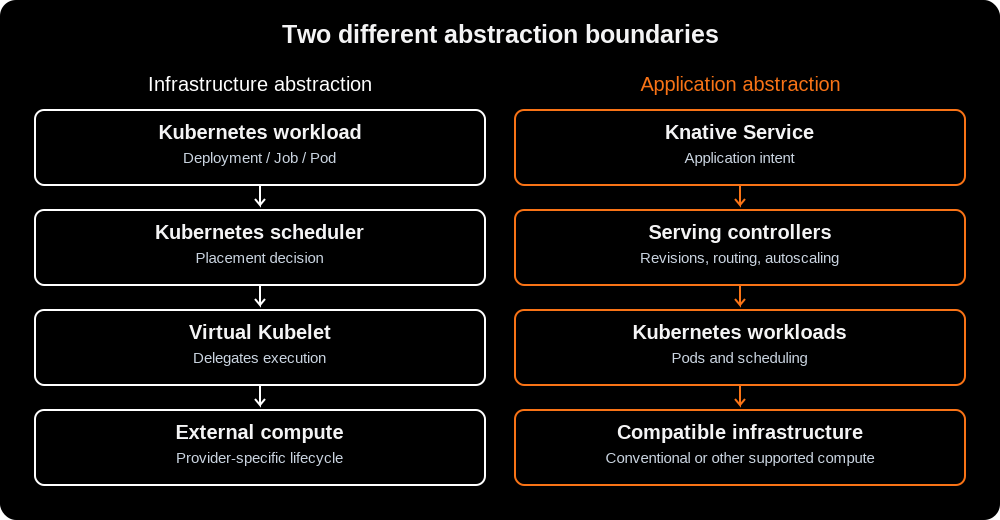
Knative addresses this different layer. Knative Serving introduces higher-level resources for deploying request-driven applications, managing revisions and routing traffic. Its autoscaling mechanisms can reduce eligible workloads to zero and bring them back when demand returns. Knative Eventing provides abstractions for connecting event producers and consumers.
Virtual Kubelet is not a prerequisite for Knative. Knative can run on conventional Kubernetes infrastructure. Combining it with virtual nodes is a separate architectural decision that requires validating provider compatibility, including networking, sidecars and workload lifecycle semantics.
The distinction is simple but important:
- Virtual Kubelet changes where and how Kubernetes delegates workload execution.
- Knative changes how applications are deployed, activated, scaled and exposed to traffic.
Choosing the right abstraction
If the problem is provisioning worker capacity, investigate node autoscaling. If the problem is delegating particular workloads to external infrastructure, investigate virtual nodes and native serverless pod integrations. If the problem is request-driven application lifecycle management, investigate Knative Serving. For event-driven workload scaling, KEDA is another relevant option; for event routing and delivery abstractions, consider Knative Eventing.
These technologies are not successive replacements for one another. They operate at different boundaries and can coexist where their requirements align.
In our earlier discussion of Kubernetes Vertical Pod Autoscaling , the central question was how much compute a workload needs. Virtual Kubelet introduces another question: where should that compute come from?
Knative introduces a third: should the application instance exist at all when nobody needs it?