Helm Library Charts at Scale: Reuse, API Design and the Abstraction Trap
Design maintainable Helm library charts for Kubernetes: reusable template APIs, security defaults, consumer testing, versioning and abstraction pitfalls.
On this page
Your platform team has standardized Kubernetes deployments behind a shared Helm library chart. Every application uses the same labels, naming conventions, security defaults and Deployment templates. Looks clean. Less duplication. Fewer inconsistencies.
Six months later, one application needs a different rollout strategy. Another requires multiple containers. A third needs an exception to a shared security setting. Your reusable chart now has 40 configuration flags, nested conditionals and a release process that can break dozens of applications.
Congratulations. You’ve eliminated YAML duplication. You’ve also created a shared API that nobody remembered to version properly.
Helm library charts solve template reuse. They don’t automatically solve platform engineering.
The difference matters once your platform grows beyond a handful of applications.
Library charts are APIs, not just template collections
A Helm library chart is a chart with type: library in its Chart.yaml. Unlike an application chart, it doesn’t render Kubernetes resources directly. It exposes named templates that consuming charts can invoke.
That sounds straightforward. And mechanically, it is. The architectural implications are less obvious.
Every named template becomes a potential interface. Every value it reads becomes an input contract. Every rendered field becomes observable behavior that application teams may depend on.
Change a helper that generates resource names, and you might force Kubernetes to replace resources. Change selector labels, and a Deployment upgrade may fail because its selector is immutable. Even a seemingly harmless change to default values can alter workload behavior across multiple applications.
Consider a simple library:
platform-library/
├── Chart.yaml
└── templates/
    ├── _names.tpl
    ├── _labels.tpl
    └── _deployment.tpl
Its Chart.yaml declares the chart type:
apiVersion: v2
name: platform-library
description: Shared Kubernetes workload templates
type: library
version: 1.0.0
The underscore-prefixed files contain named templates rather than independently rendered manifests. A consuming application declares the library as a dependency and invokes those templates.
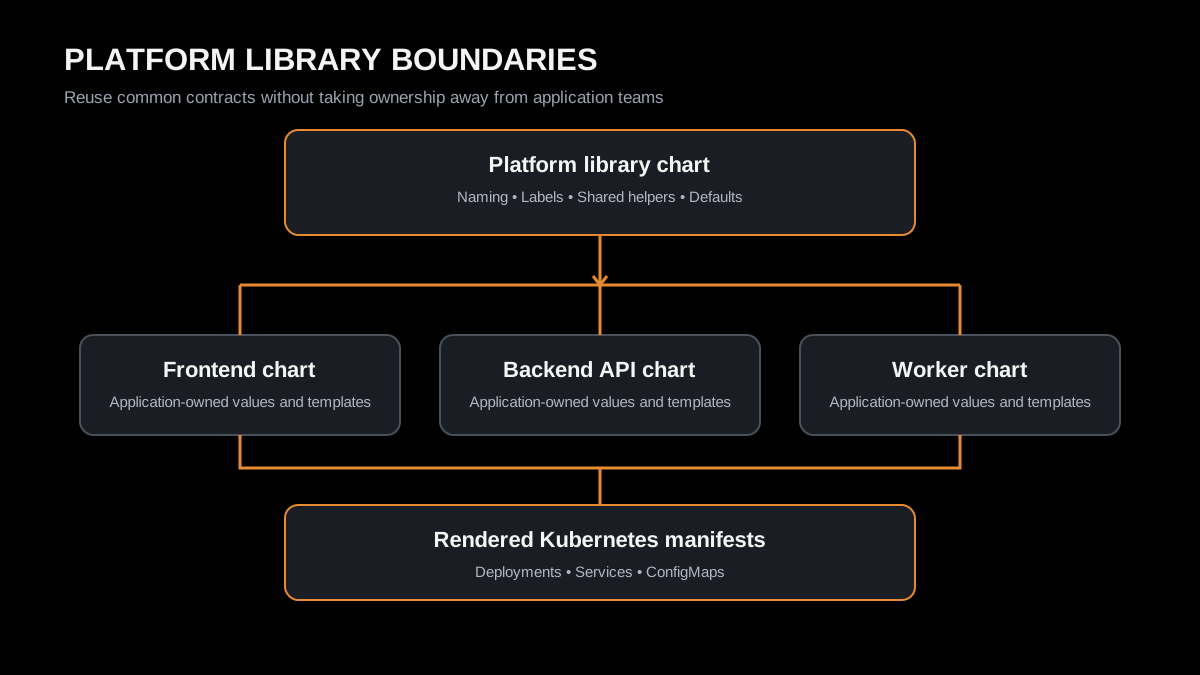
This is useful precisely because application teams can reuse established patterns without surrendering control of every workload-specific decision. But that boundary needs to be intentional.
Start with a small, explicit template contract
A common mistake is to begin with a universal Deployment template supporting every conceivable Kubernetes feature. Sidecars. Init containers. Affinity. Topology spread constraints. Volumes. Security contexts. Every possible probe. Dozens of conditional branches. Eventually, the template becomes harder to understand than the Kubernetes API it was supposed to simplify.
Start smaller. A useful first abstraction is resource naming. It is repeated across charts, has clear semantics and can be tested independently.
{{- define "apefactory.platform.fullname" -}}
{{- $root := .root -}}
{{- $component := .component | default "" -}}
{{- $name := default $root.Chart.Name $root.Values.nameOverride -}}
{{- $base := default (printf "%s-%s" $root.Release.Name $name) $root.Values.fullnameOverride -}}
{{- $full := $base -}}
{{- if $component -}}
  {{- $full = printf "%s-%s" $base $component -}}
{{- end -}}
{{- $full | trunc 63 | trimSuffix "-" -}}
{{- end -}}
The consumer invokes it with an explicit context:
metadata:
  name: {{ include "apefactory.platform.fullname" (dict "root" . "component" "api") }}
Why pass a dictionary instead of relying on the implicit root context?
Because the helper now has an identifiable interface: a Helm context and an optional component name. It is easier to document, test and extend without silently changing how callers behave. This example is deliberately minimal. Production naming also needs collision handling when truncation removes distinguishing suffixes, particularly for dynamically generated resources.
Names are not merely cosmetic in Kubernetes. Changing one can change resource identity.
Labels are where careless abstractions become expensive
Kubernetes labels look harmless until you change the wrong ones.
A Deployment’s selector is immutable. If your shared library generates selectors from customizable labels, an innocent library update can make existing workloads impossible to upgrade in place. Separate selector identity from descriptive metadata.
{{- define "apefactory.platform.selectorLabels" -}}
app.kubernetes.io/name: {{ .Chart.Name | quote }}
app.kubernetes.io/instance: {{ .Release.Name | quote }}
{{- end -}}

{{- define "apefactory.platform.labels" -}}
{{ include "apefactory.platform.selectorLabels" . }}
app.kubernetes.io/managed-by: {{ .Release.Service | quote }}
helm.sh/chart: {{ printf "%s-%s" .Chart.Name .Chart.Version | replace "+" "_" | quote }}
{{- end -}}
The Deployment uses the same stable selector helper in both locations:
spec:
  selector:
    matchLabels:
      {{- include "apefactory.platform.selectorLabels" . | nindent 6 }}
  template:
    metadata:
      labels:
        {{- include "apefactory.platform.labels" . | nindent 8 }}
Additional application labels can be supported separately, provided they cannot override the selector identity.
The important design decision is not which labels you generate. It is deciding which fields are part of the compatibility contract and which fields consumers may customize. That distinction becomes critical when multiple teams depend on the same library.
Reuse workload patterns without hiding Kubernetes
A library chart can expose complete resource templates. That does not mean every resource should be abstracted.
Consider a Deployment helper with a deliberately limited contract:
{{- define "apefactory.platform.deployment" -}}
{{- $root := .root -}}
{{- $workload := .workload -}}
apiVersion: apps/v1
kind: Deployment
metadata:
  name: {{ include "apefactory.platform.fullname" (dict "root" $root "component" $workload.name) }}
  labels:
    {{- include "apefactory.platform.labels" $root | nindent 4 }}
spec:
  replicas: {{ $workload.replicas }}
  selector:
    matchLabels:
      {{- include "apefactory.platform.selectorLabels" $root | nindent 6 }}
  template:
    metadata:
      labels:
        {{- include "apefactory.platform.labels" $root | nindent 8 }}
    spec:
      containers:
        - name: {{ $workload.name }}
          image: {{ $workload.image | quote }}
          ports:
            - name: http
              containerPort: {{ $workload.port }}
          resources:
            {{- toYaml $workload.resources | nindent 12 }}
{{- end -}}
Notice what this template doesn’t do. It doesn’t implement every Kubernetes Deployment option. It doesn’t introduce a custom configuration language for scheduling, storage or networking. It handles a specific workload pattern.
The application chart provides the configuration:
# values.yaml
workload:
  name: api
  replicas: 2
  image: registry.example.com/api@sha256:<digest>
  port: 8080
  resources:
    requests:
      cpu: 100m
      memory: 128Mi
    limits:
      memory: 256Mi
Replace <digest> with an actual image digest before deploying the workload.
The consuming template invokes the library:
{{- include "apefactory.platform.deployment" (dict "root" . "workload" .Values.workload) -}}This illustrates the interface, not a universal production Deployment. The consuming chart must validate required fields, and production workloads may need ServiceAccounts, probes, scheduling configuration and additional security controls.
There is also a deliberate constraint here: the selector uses application-level identity. It is suitable for one Deployment per consuming chart, but not multiple Deployments sharing the same selector labels. Supporting multiple components requires a component-aware selector contract from the beginning.
That is precisely why abstractions should grow from demonstrated requirements rather than anticipated possibilities.
Security defaults are not security enforcement
Platform teams frequently use Helm libraries to standardize security settings. Reasonable defaults include running containers as non-root, disabling privilege escalation, dropping Linux capabilities and using restrictive seccomp profiles.
For example:
securityContext:
  allowPrivilegeEscalation: false
  capabilities:
    drop:
      - ALL
  seccompProfile:
    type: RuntimeDefault
These settings belong at the container level. Other controls, such as runAsNonRoot, can be configured at the Pod or container level. But there is a fundamental limitation.
A Helm library is not a security boundary.
An application team can modify its chart, override values or stop consuming the library entirely.
If your organization requires specific security guarantees, enforce them at admission time using Kubernetes Pod Security Admission, Kyverno or Gatekeeper, depending on the policy requirements. This is particularly relevant in multi-tenant Kubernetes and OpenShift environments.
Helm libraries provide reusable deployment conventions. Admission policies provide enforceable constraints. RBAC controls who can perform operations.
They solve different problems. Trying to turn a Helm template into a mandatory security control confuses configuration convenience with enforcement.
Validate the contract before Kubernetes sees it
Helm values are dynamically typed inputs to a template engine. Without validation, malformed configuration often produces confusing rendering failures or invalid Kubernetes manifests.
A values.schema.json provides a first line of defense.
For the example workload:
{
  "$schema": "https://json-schema.org/draft-07/schema#",
  "type": "object",
  "required": ["workload"],
  "properties": {
    "workload": {
      "type": "object",
      "required": ["name", "replicas", "image", "port", "resources"],
      "properties": {
        "name": {"type": "string", "pattern": "^[a-z][a-z0-9-]*$"},
        "replicas": {"type": "integer", "minimum": 0},
        "image": {"type": "string", "minLength": 1},
        "port": {"type": "integer", "minimum": 1, "maximum": 65535},
        "resources": {"type": "object"}
      }
    }
  }
}
Place this schema in the consuming application chart. A library chart’s schema is not a substitute for validating the consumer’s root-level values contract. Schema validation catches configuration errors before they become deployment failures. It does not guarantee that the rendered resources are valid against a particular Kubernetes version. For that, you need another validation layer.
Test library charts through their consumers
A library chart doesn’t render standalone resources. Testing only the library’s files misses the actual contract: how application charts consume its templates.
Create a fixture chart that declares the library as a dependency.
# test-consumer/Chart.yaml
apiVersion: v2
name: test-consumer
version: 0.1.0
dependencies:
  - name: platform-library
    version: 1.0.0
    repository: file://../platform-library
Then validate it:
cd test-consumer
helm dependency update
helm lint . --strict
helm template test-release . --values values.yaml > rendered.yaml
The generated manifests should be validated against the Kubernetes API version you actually support, using a schema validation tool such as kubeconform. A cluster-backed validation can catch additional issues:
kubectl apply --dry-run=server -f rendered.yamlThis requires access to a compatible Kubernetes API server and sufficient permissions. It can also invoke admission webhooks, so it is not equivalent to offline validation.
More importantly, test behavior across library changes. A useful test matrix includes zero replicas, multiple releases, long resource names, custom labels, missing required values and security configuration. The goal is not merely to prove that the template renders. It is to detect unexpected changes to the resources your applications already depend on.
Version the behavior, not just the chart
Helm library charts have versions. That doesn’t automatically make their interfaces stable. A patch release that changes a resource name is not harmless simply because the template still renders. A minor release that changes selectors can be operationally breaking, regardless of whether the author intended it as an improvement.
Treat the public template interface as an API.
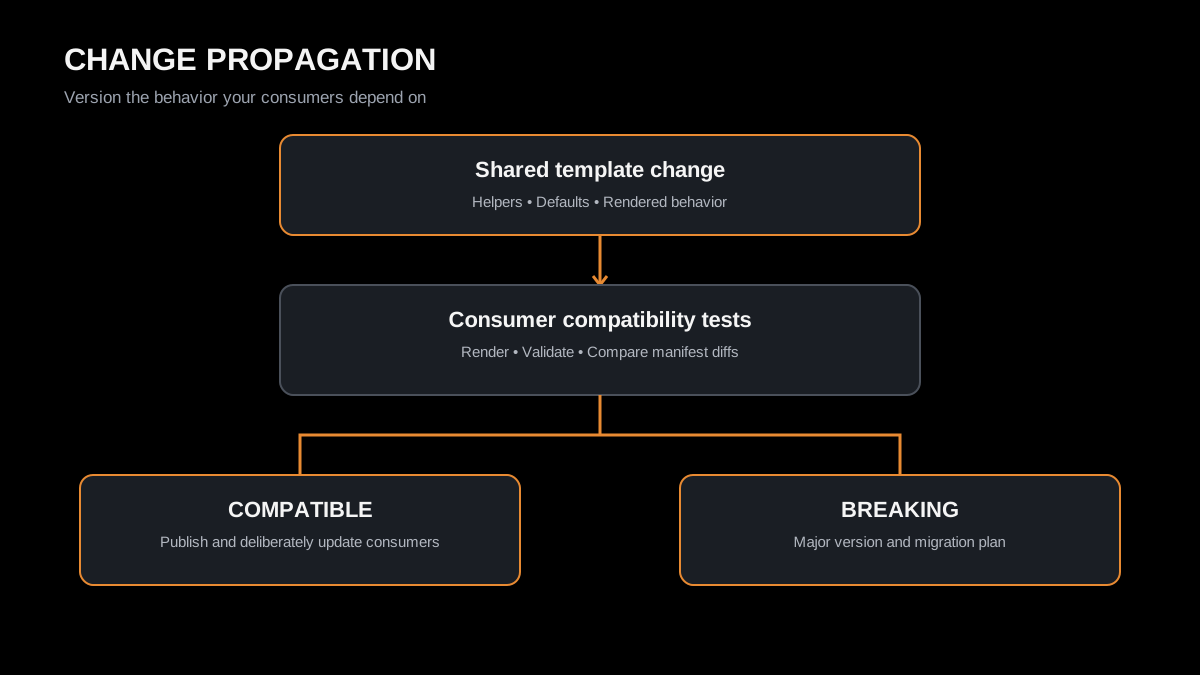
Use semantic versioning based on compatibility, not just template file changes. For reproducible deployments, prefer exact library dependency versions and commit the generated Chart.lock.
dependencies:
  - name: platform-library
    version: 1.0.0
    repository: https://charts.example.com
Update dependencies deliberately, run the consumer test suite and review the rendered manifest differences. A shared library update should be a controlled platform change, not a surprise during an unrelated application deployment.
When a library chart is the wrong abstraction
Not every repeated YAML fragment deserves a shared library.
If two applications have fundamentally different lifecycle requirements, forcing them through one universal Deployment template may increase complexity rather than reduce it.
Sometimes a small application-specific chart is easier to maintain. Sometimes Kustomize is sufficient for environment-specific manifest customization. And sometimes the real requirement is policy enforcement, which belongs outside Helm entirely.
The question is not whether two Kubernetes resources look similar. The question is whether they share a stable behavioral contract.
If that contract exists, a library chart can be an effective abstraction. If it doesn’t, the library may simply move complexity from individual applications into a central dependency.
The real cost of reuse
Helm library charts are valuable. They reduce repetitive template logic, establish conventions and help platform teams provide consistent deployment patterns.
But reuse introduces coupling.
Once dozens of applications depend on a shared library, every template change has a potential blast radius. Every undocumented value becomes technical debt. Every breaking default becomes somebody else’s deployment problem.
The answer isn’t to abandon library charts. It’s to treat them like software libraries: define interfaces, test consumers, version behavior and keep the public API deliberately small.
A good Helm library removes duplication. A great one removes duplication without taking away the application’s ability to evolve.
That’s the difference between a collection of reusable templates and an actual platform abstraction.