Helm Hooks at Scale: When Deployment Automation Becomes a Liability
Helm hooks automate release lifecycle operations but cannot guarantee transactional deployments. Explore database migrations, idempotency, rollback failures and GitOps trade-offs.
On this page
Your Helm upgrade failed. The Deployment never changed. The new Pods never started. Kubernetes is still running the previous application version.
Looks like nothing happened. Except your pre-upgrade hook already modified the database schema. The migration Job completed successfully. The application upgrade didn’t. Now your old application is running against a new database schema.
Congratulations. Your deployment failed before the application changed. Your database didn’t get the memo.
Helm hooks execute lifecycle operations. They don’t make those operations transactional.
That distinction matters when hooks start managing database migrations, credentials, external services and other operations with consequences beyond Kubernetes manifests.
Helm hooks are lifecycle callbacks, not transactions
Helm hooks are Kubernetes resources annotated to execute at specific points in a release lifecycle. They support events such as pre-install, post-install, pre-upgrade, post-upgrade, pre-rollback and post-rollback.
A typical upgrade looks like this:
The diagram could not be displayed. Its source is available below.
Diagram source
flowchart LR
    A["helm upgrade"] --> B["pre-upgrade hooks"]
    B --> C["Update release resources"]
    C --> D["post-upgrade hooks"]
    D --> E["Release completes"]
Helm executes hooks according to their weights, resource kinds and names. Lower weights execute first. For Job hooks, Helm waits for successful completion before proceeding. A failed Job can cause the release operation to fail.
But the important limitation is what happens outside Helm’s control. A hook might modify a database, call an external API or rotate credentials. Those changes are not automatically reversed when the release fails.
Even --atomic in Helm 3, or its corresponding rollback-on-failure behavior in newer Helm versions, cannot restore an external database to its previous state.
Helm can roll back Kubernetes release resources. It cannot roll back arbitrary side effects.
That is the fundamental constraint every production hook design must acknowledge.
Database migrations expose the problem immediately
Database migrations are a common reason to introduce Helm hooks. The application requires a new schema. The migration must complete before the new Pods start.
A pre-upgrade Job appears to solve the ordering problem.
Consider this minimal template:
apiVersion: batch/v1
kind: Job
metadata:
  name: {{ .Release.Name }}-migrate
  annotations:
    "helm.sh/hook": pre-upgrade
    "helm.sh/hook-weight": "-5"
    "helm.sh/hook-delete-policy": before-hook-creation
spec:
  backoffLimit: 0
  activeDeadlineSeconds: 600
  template:
    spec:
      restartPolicy: Never
      containers:
        - name: migrate
          image: {{ .Values.migration.image | quote }}
          command:
            - /app/migrate
            - up
          env:
            - name: DATABASE_URL
              valueFrom:
                secretKeyRef:
                  name: {{ .Values.database.secretName | quote }}
                  key: url
The migration image should be pinned to an immutable digest, contain the migration tool and match the schema expected by the application release. This Job runs before Helm updates the application resources. If the migration fails, Helm stops the upgrade.
So far, so good.
Now consider what happens when the migration succeeds but the application Deployment fails because of an invalid configuration, missing Secret or incompatible container image.
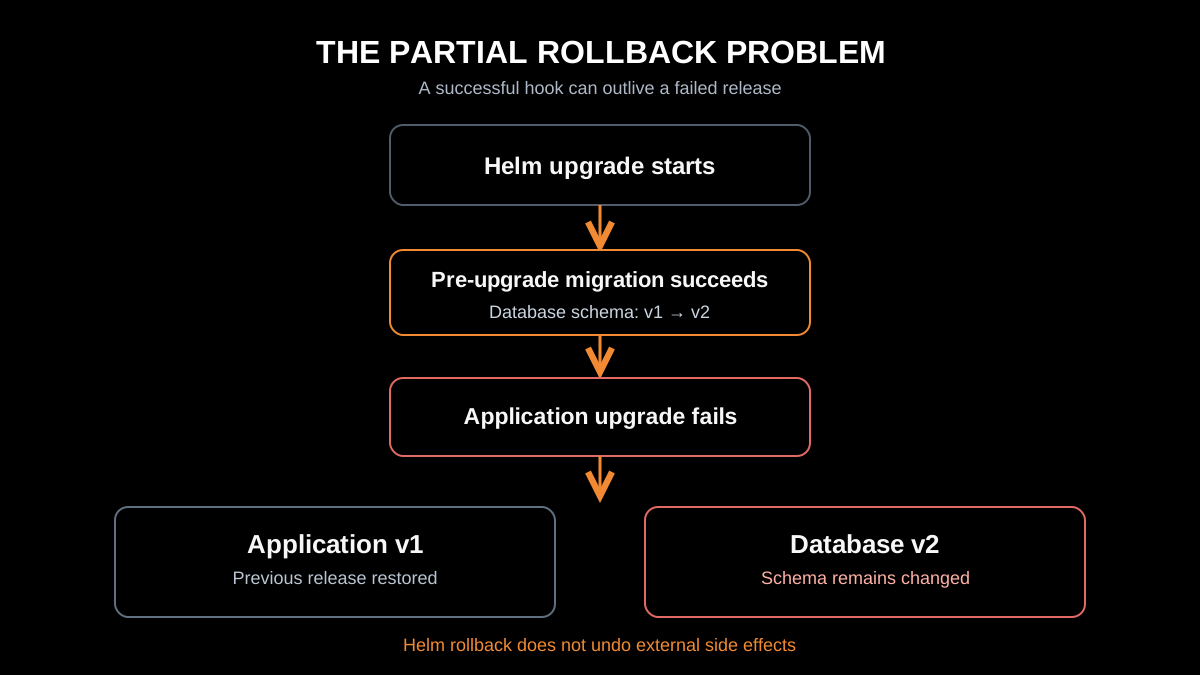
Your application and database are now running different versions. Whether the system survives depends on schema compatibility, not Helm.
Design migrations for compatibility, not automatic reversal
The safer approach is usually expand-and-contract schema evolution.
First, introduce backward-compatible schema changes. Add columns, tables or indexes without immediately removing structures used by the existing application. Next, deploy the new application version. Both versions should tolerate the transitional schema. Only after the old application version is no longer required should you remove obsolete schema elements. This separates database evolution from the assumption that every deployment can be reversed as one operation. It also makes failed application rollouts substantially less dangerous.
A database backup is still useful, but it is not a substitute for compatibility. Restoring a database may require downtime and can discard writes performed after the backup.
And automatically executing a destructive migration downgrade after a failed upgrade? That is a particularly bad idea.
Idempotency matters more than hook weights
Helm hooks can run more than once. An operator might retry an upgrade. A GitOps controller might reconcile again. A failed Job might be recreated during a subsequent release attempt. Your hook must account for repeated execution.
For database migrations, use a migration framework that records applied versions and handles concurrent execution appropriately. For external API calls, use idempotency keys or reconciliation semantics.
For initialization tasks, check whether the required state already exists. A hook should ideally converge toward the desired state rather than assume it is executing for the first time.
Consider:
spec:
  backoffLimit: 0
  activeDeadlineSeconds: 600
backoffLimit: 0 prevents Kubernetes from retrying a failed Job through its normal Job retry mechanism.
activeDeadlineSeconds bounds the Job’s execution time.
Neither guarantees exactly-once execution. They control Job behavior, not the semantics of the external operation. Even a Job that exits unsuccessfully may have completed part of its work. A network timeout after an API request is a classic example. The remote system might have accepted the operation even though the hook never received the response. Retrying blindly can create duplicate side effects.
Exactly-once behavior cannot be created by adding a Helm annotation.
Hook cleanup is an operational decision
Hook-created resources are not managed like ordinary release resources. You need to define how they are deleted and how failed executions remain observable.
A common configuration is:
metadata:
  annotations:
    "helm.sh/hook": pre-upgrade
    "helm.sh/hook-delete-policy": before-hook-creation,hook-succeeded
This removes successful hook resources while retaining failed ones until a later hook execution or another cleanup mechanism removes them. That can be useful during troubleshooting.
However, Kubernetes Jobs may also use ttlSecondsAfterFinished, which can remove completed Jobs regardless of whether they succeeded or failed. If you retain failures for debugging, don’t configure a short TTL that removes the evidence before anyone investigates.
For production, send logs and relevant execution results to centralized observability systems. A Job disappearing from the namespace should not erase the operational history of a deployment. Also, avoid treating hook Jobs as permanent audit records. They are execution resources, not an audit system.
Canary deployments are not a Helm hook problem
The original attraction of hooks is understandable. You deploy an application, wait five minutes, query Prometheus and decide whether the deployment succeeded.
A post-upgrade hook can run that analysis.
But it doesn’t automatically control traffic distribution. It doesn’t establish a canary rollout strategy. And it doesn’t guarantee that the observed metrics belong to the new application version. A query that combines metrics from old and new Pods may hide a failing canary. Worse, treating missing metrics as a zero-percent error rate turns an observability failure into a deployment success.
For progressive delivery, use a controller designed to manage rollout stages and traffic shifting, such as Argo Rollouts or Flagger. Those systems are designed to coordinate deployment progression with analysis. Helm hooks can still perform bounded validation tasks, but they should not become an improvised progressive delivery engine.
Secret rotation has a different lifecycle
Rotating database credentials during pre-upgrade introduces another failure boundary. The new credentials might become active before the application has successfully switched to them. Old Pods may continue running with the previous credentials.
If those credentials are revoked too early, the existing application can lose database access even though the upgrade failed. Credential rotation should account for overlapping validity, workload rollout timing and explicit revocation.
For many Kubernetes platforms, dedicated secret-management integrations are better suited to this task than release hooks. External Secrets Operator, Secrets Store CSI Driver and external secret-management systems can help manage synchronization and delivery. They do not eliminate the need for a safe rotation protocol, but they separate credential lifecycle management from an application chart upgrade.
That separation is valuable. A routine Helm release should not unexpectedly become responsible for revoking production credentials.
GitOps adds another layer of lifecycle semantics
Helm hooks were designed around Helm release operations. GitOps controllers introduce continuous reconciliation. That changes the operational context.
Flux Helm Controller manages Helm releases and can execute Helm hooks through Helm’s release lifecycle.
Argo CD supports Helm hook annotations, but its deployment model uses its own synchronization lifecycle and hook semantics.
These behaviors should not be assumed equivalent. For example, hook execution, retries, deletion policies and failure handling can differ depending on the controller and its configuration.
A chart tested using the Helm CLI is not automatically validated for identical lifecycle behavior under every GitOps controller. The correct approach is to test the actual deployment mechanism used in production. If the platform deploys through Flux, validate hook behavior through Flux. If it deploys through Argo CD, validate the synchronization behavior through Argo CD.
Do not assume that successful helm template output proves the operational behavior of a hook. Rendering validates templates. It does not execute lifecycle operations.
Choose the mechanism that matches the failure model
Not every release-time operation needs an external workflow engine. Helm hooks remain useful when the task is bounded, repeatable and closely tied to a release. A smoke test after installation is a reasonable example. A small initialization Job may also be appropriate if it can safely run multiple times and has clear failure behavior.
But as the workflow grows, the architecture should change.
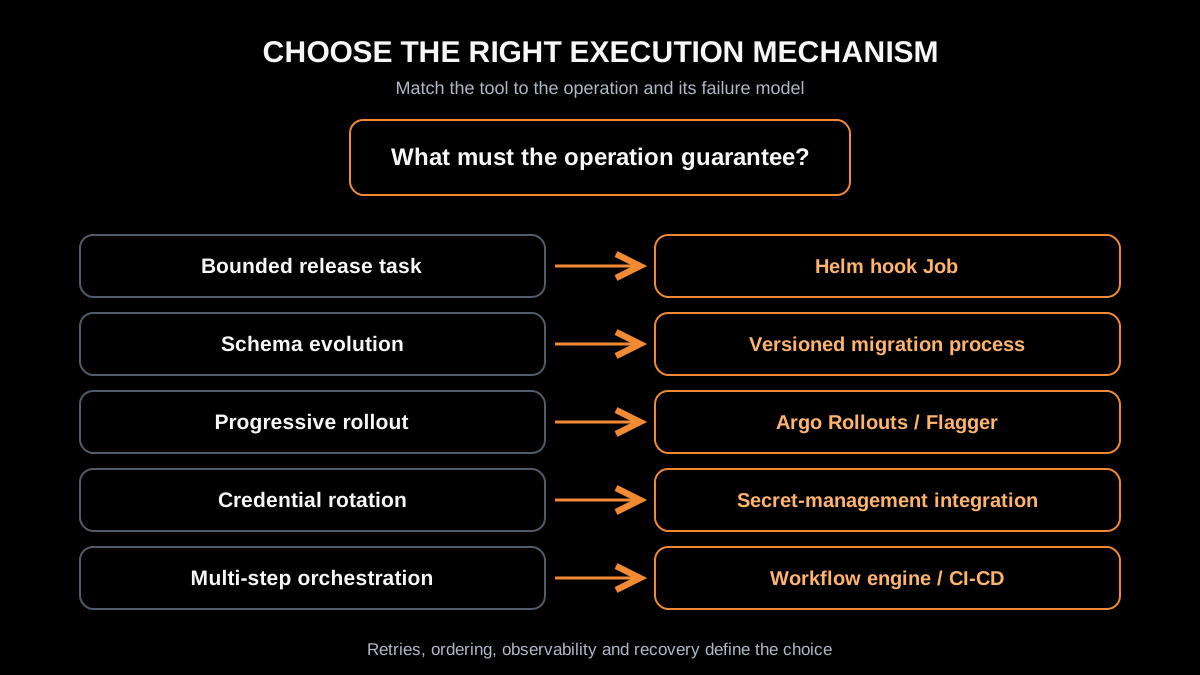
| Requirement | Better starting point |
|---|---|
| Small release-time initialization | Helm hook Job |
| Database schema evolution | Versioned migration process with compatibility controls |
| Progressive traffic shifting | Argo Rollouts or Flagger |
| Credential rotation | Dedicated secret-management integration |
| Multi-step external orchestration | Workflow engine or controlled CI/CD process |
| Post-deployment smoke testing | Helm test, CI/CD validation or GitOps-compatible testing |
The deciding factor isn’t whether the task can be implemented in a Kubernetes Job. Almost anything can. The question is whether the execution mechanism provides the ordering, retry, observability and recovery guarantees the operation requires.
The deployment boundary is not the system boundary
Helm hooks are useful because they let application releases coordinate additional operations. But that convenience creates a temptation to move increasingly complex workflows into chart templates. Database backups. Schema migrations. Secret rotation. External service registration. Canary analysis.
Eventually, a simple helm upgrade becomes responsible for coordinating systems that Helm cannot restore when something goes wrong. The resulting automation may look elegant in YAML. Its failure model is anything but elegant.
Use hooks for bounded release lifecycle tasks. Make operations idempotent. Define timeouts and cleanup behavior. Test failure scenarios under the deployment controller you actually use. And never confuse a successful Helm rollback with a successful system recovery.
Your Kubernetes manifests might be back where they started. Your database, credentials and external systems might not be.
That’s the difference between deployment automation and reliable platform engineering.